Walls That Belong to Everyone: How Ordinary Neighbors Are Turning Forgotten Spaces Into Living Art
There's a wall on the corner of Holman and Wheeler in Houston's Third Ward that used to be just another blank slab of concrete — the kind of surface that collects grime and the occasional flyer for a show that already happened. Now it's a 60-foot portrait of a neighborhood elder named Miss Etta, her face rendered in warm ochres and deep blues, surrounded by symbols drawn from the community's history.
Miss Etta didn't commission the mural. She didn't even know it was being planned until a group of teenagers from the block knocked on her door to ask if they could photograph her for reference. She cried when she saw the finished piece.
That's the thing about community murals done right. They don't just change how a wall looks. They change how a neighborhood sees itself.
The Difference Between Art For Communities and Art By Them
Public art has a complicated history in America. For every beloved community mural, there's a cautionary tale — the abstract sculpture nobody asked for, dropped in front of a government building by a committee that never walked the block; the corporate-sponsored mural that shows up looking like a brand activation rather than a neighborhood story.
The projects that actually take root and mean something share a common characteristic: the community is in the room from the very beginning. Not as an audience. As a co-author.
"There's a huge difference between a mural that depicts a community and a mural that comes from one," says Amara Osei, a Detroit-based muralist who has facilitated collaborative projects across the Midwest for the past decade. "The first one can be beautiful and still feel like it was done to you. The second one feels like yours."
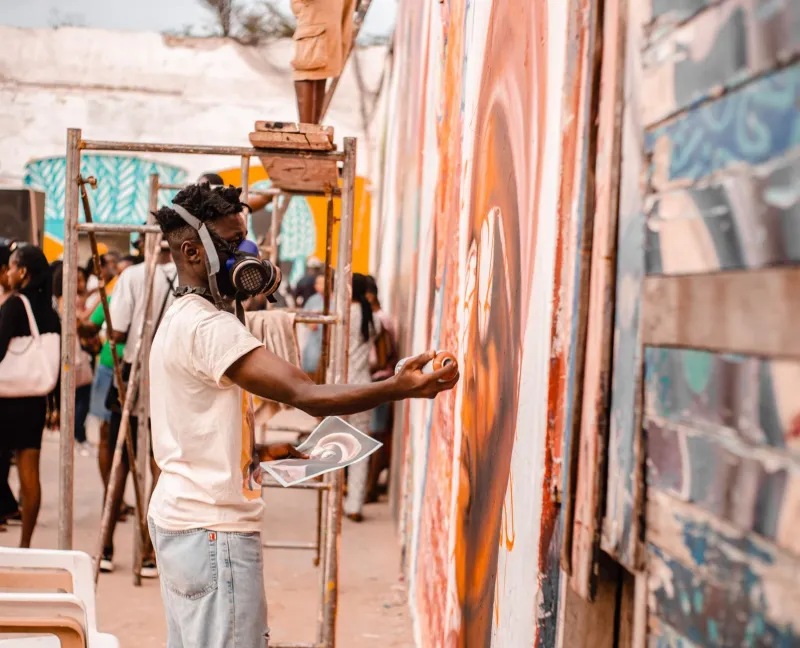
Osei's process involves months of community engagement before a single sketch is drawn — neighborhood meetings, one-on-one conversations with elders and young people, archival research into local history. The actual painting, when it happens, often involves dozens of residents alongside the lead artist.
Detroit: Building Back Block by Block
Few American cities have more empty walls than Detroit, and few have done more interesting things with them. The city's decades-long population decline left vast stretches of the urban landscape vacant or underused — a crisis that community arts organizations have been quietly, persistently turning into an opportunity.
The Detroit Mural Project, which operates in partnership with neighborhood associations across the city, has facilitated over 200 community-led murals since 2009. The organization's model is deliberately decentralized: each project is led by a local artist selected from the neighborhood where the mural will live, and the design process is driven by community input gathered through workshops, surveys, and plain old kitchen-table conversations.
In the Brightmoor neighborhood — long considered one of Detroit's most challenged — a series of murals painted on the sides of vacant lots has helped anchor a block-by-block revitalization effort. Residents report that the murals have reduced illegal dumping, increased foot traffic, and created gathering points where neighbors who'd never spoken to each other now stop and talk.
"People underestimate how much a beautiful thing in a forgotten place can shift the energy," says Brightmoor resident and project volunteer Darnell Washington. "It's like the neighborhood is saying, 'We're still here. We matter.'"
The Bronx: Reclaiming Roots in Real Time
In New York's South Bronx — the birthplace of hip-hop and a neighborhood that has long been used as shorthand for urban decline — a new generation of community muralists is actively rewriting that narrative.
The BronxArtSpace collective has been coordinating collaborative mural projects across the borough since 2015, with a particular focus on amplifying voices that rarely appear in mainstream cultural spaces: undocumented immigrants, formerly incarcerated residents, LGBTQ+ youth of color, Indigenous community members.
One recent project, a sprawling multi-panel mural on a community center in Mott Haven, took eight months to complete and involved over 120 residents in its creation. The panels trace the neighborhood's history from its Indigenous roots through the waves of Puerto Rican, Dominican, and West African migration that shaped its current identity — a visual timeline that the neighborhood's own children helped research and design.
"Our kids don't see themselves in textbooks. They don't see themselves in museums. But they walk past this wall every single day," says BronxArtSpace co-founder Marisol Rivera. "That matters. Representation in your own neighborhood matters."
The Economics of Beauty: Do Murals Actually Help?
Skeptics sometimes raise a legitimate concern: community murals can be a precursor to gentrification, raising property values in ways that ultimately displace the very residents who created them. It's a real tension, and honest advocates don't pretend otherwise.
But the research picture is nuanced. Studies from the Urban Land Institute and various city planning departments have found that community-led public art projects — particularly those with strong neighborhood ownership and ongoing community governance — tend to produce different outcomes than developer-driven beautification efforts. When residents control the narrative and the process, the benefits are more likely to stay in the community.
Philadelphia's Mural Arts Program, which has been running longer than almost any comparable initiative in the country, has documented consistent correlations between mural projects and reduced vacancy rates, increased community organization participation, and improved perceptions of neighborhood safety — without the displacement patterns associated with top-down development.
The key, researchers suggest, is that the art signals investment by a community rather than in it — a subtle but crucial distinction that affects how outside capital interprets and responds to the signal.
How to Start Something in Your Own Neighborhood
If you're reading this and thinking about your own block — that underpass, that vacant lot wall, that crumbling retaining wall that's been tagged and painted over so many times it's basically a geological record of the neighborhood — here's what the people doing this well say you need to know.
Start with listening, not designing. Before you think about what the mural should look like, spend time understanding what the community actually wants to say. Host informal conversations. Ask elders about the neighborhood's history. Ask teenagers what they wish people knew about where they live.
Find your local artist. The best community murals are made by artists who have a genuine relationship with the neighborhood. Look to local arts organizations, community centers, and neighborhood associations for connections.
Secure the wall before you get attached to anything. Property owner permission is non-negotiable, and getting it early saves heartbreak later. Many owners are enthusiastic once they understand what's being proposed.
Apply for funding early and from multiple sources. City arts councils, neighborhood improvement grants, local business sponsorships, and crowdfunding can all be part of the mix. Organizations like Americans for the Arts maintain databases of public art funding opportunities.
Plan for maintenance. A mural that fades or gets tagged without response can undermine community pride rather than build it. Build a maintenance plan into the project from the start.
The walls of America's neighborhoods have always been talking. The question is who gets to decide what they say. When the answer is the community itself — when Miss Etta's neighbors are the ones holding the brushes — the conversation gets a whole lot more interesting.