Murals, Money, and Moving Vans: How Street Art Got Tangled Up in the Displacement Machine
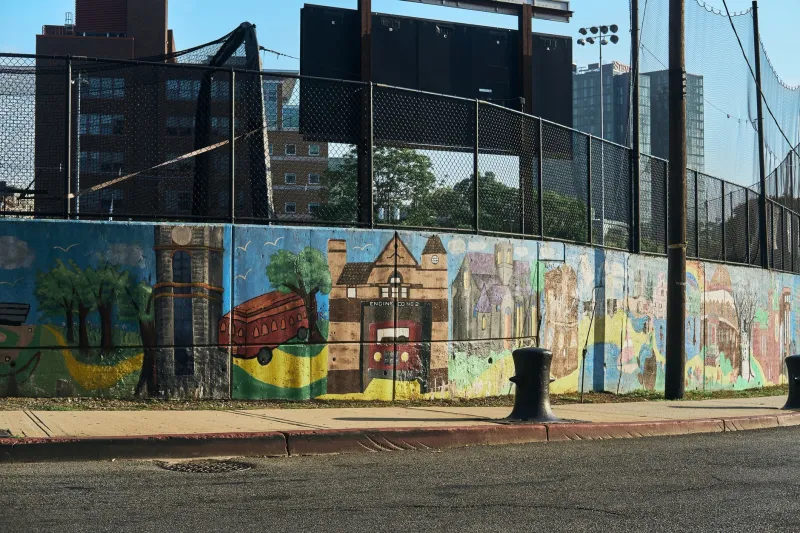
There's a mural on the corner of a block in Denver's RiNo district that's been photographed roughly ten thousand times. Tourists pose in front of it. Influencers tag it. A luxury apartment complex half a block away used a cropped version of it in their leasing brochure — without permission, without credit, and without any apparent sense of irony. The artist who painted it grew up in that neighborhood. She no longer lives there. She can't afford to.
This is the gentrification paradox that nobody in the street art world really wants to talk about, but everybody is living through. Public art — raw, community-rooted, often created specifically as an act of resistance — keeps getting conscripted into the service of exactly the forces it was pushing back against.
The "Cool" Tax Nobody Asked For
Urban planners have a term for it: the amenity effect. The basic idea is that when a neighborhood develops cultural cachet — galleries, murals, food trucks, music venues — property values follow. It sounds neutral when economists say it. It doesn't feel neutral when your landlord triples your rent because your block is now described as "vibrant" in a New York Times travel piece.
Researchers at the National Community Reinvestment Coalition have documented this cycle in cities from Philadelphia to Portland, tracking how arts investment consistently precedes — and often predicts — displacement of lower-income residents. Street art, with its photogenic immediacy and zero-cost marketing potential, has become one of the most efficient engines of that process.
"We didn't paint these walls to make somebody's condo development more attractive," says Marcus Webb, a muralist who's worked in Chicago's Pilsen neighborhood for over a decade. "We painted them because this community had stories worth telling. Now those stories are literally being used to sell real estate to people who are pushing the storytellers out."
Pilsen is practically a textbook case. For years, its Mexican-American community built one of the most visually stunning concentrations of public art in the Midwest — a living gallery that stretched across warehouses, viaducts, and corner stores. Then the developers arrived, and the murals stayed while the people who made them scattered to the suburbs.
The Developer Playbook
It's worth being clear about how this actually works, because it's rarely as crude as someone slapping a mural up and watching rents rise overnight. The mechanism is more insidious than that.
First, artists — often priced out of established neighborhoods — move into affordable areas. They create culture. That culture generates foot traffic, press coverage, and a reputation for authenticity. Developers and investors, always scanning for undervalued neighborhoods with upside potential, identify the art scene as a signal. They move in. They sometimes even commission murals themselves, understanding that public art functions as free place-branding.
City governments frequently play a role too, whether intentionally or not. Public art grant programs, mural festivals, and arts district designations can all accelerate the cycle. A city invests in beautification; the neighborhood becomes more desirable; longtime residents get priced out; the art remains as a kind of cultural trophy for the newcomers.
"There's this thing I call 'aesthetic colonialism,'" says Dr. Renata Fuentes, a urban studies professor at the University of Texas at Austin who studies creative placemaking and its social consequences. "You extract the aesthetic value of a community's culture while displacing the community itself. The art stays. The people leave. And the people who move in get to feel like they're living somewhere authentic without ever having to reckon with what authenticity actually cost."
Artists Caught in the Middle
For many street artists, this creates an almost impossible position. Accepting a paid commission from a developer feels like collaboration with the displacement machine. Refusing means the wall gets a Whole Foods ad instead. Painting for free in a struggling neighborhood is an act of solidarity — until the neighborhood stops struggling and starts getting expensive, and suddenly your mural is in a real estate flyer.
Some artists have started building explicit community protections into their work. Cleo Diaz, who works primarily in Los Angeles, now includes a contractual clause in any paid mural agreement prohibiting the use of her work in real estate marketing materials. "It doesn't stop gentrification," she says, "but it at least means my hands aren't directly on the wheel."
Others are going further, actively creating work that functions as a form of counter-narrative. In Atlanta's Old Fourth Ward — another neighborhood that has undergone dramatic transformation — a collective called Ground Level has been installing murals that explicitly document the displacement happening around them: portraits of longtime residents, timelines of rent increases, the names of businesses that closed. The murals aren't there to make the neighborhood look cool. They're there to make sure the neighborhood remembers what it lost.
Fighting Back From the Ground Up
A handful of communities are experimenting with structural responses to the cycle. In San Francisco, community land trusts have begun incorporating public art spaces into their models, ensuring that creative infrastructure remains in community hands even as surrounding property values climb. In Detroit — which has its own complicated relationship with art-led revitalization — some neighborhood organizations are demanding formal community benefit agreements before approving large-scale public art projects, requiring developers who benefit from arts amenities to contribute to affordable housing funds.
These aren't perfect solutions. Land trusts move slowly. Community benefit agreements are only as strong as the political will to enforce them. And the market pressure on desirable urban neighborhoods is relentless in ways that local organizing can only partially resist.
But the conversation itself matters. For too long, street art operated under a kind of political innocence — the assumption that putting beautiful things on walls was inherently good, inherently progressive, inherently on the side of the community. The gentrification paradox has forced a more complicated reckoning.
Whose Walls, Whose Story?
Back in Denver, the artist whose mural ended up in that apartment leasing brochure — her name is Valentina Cruz — has a complicated relationship with what happened. She's angry, yes. But she's also still painting. Her new work is in a neighborhood further east, one that's currently under the radar, where she grew up and where her mother still lives.
"I'm not going to stop making art because developers are going to exploit it," she told us. "But I'm more intentional now. I talk to the block before I paint it. I make sure the people who live there feel like it belongs to them, not to me, and definitely not to whoever owns the building."
That instinct — art as a conversation with a community rather than a product for a market — might be the most important thing street art can hold onto right now. The walls will keep getting painted. The question is whether the people who inspired them will still be around to see them.
And that's not really an art question. It's a power question. It's about who gets to stay in the city they built, and who gets pushed to the margins while their culture gets repackaged and sold back to strangers.
The streets are still speaking. We just need to make sure we're listening to the right voices.